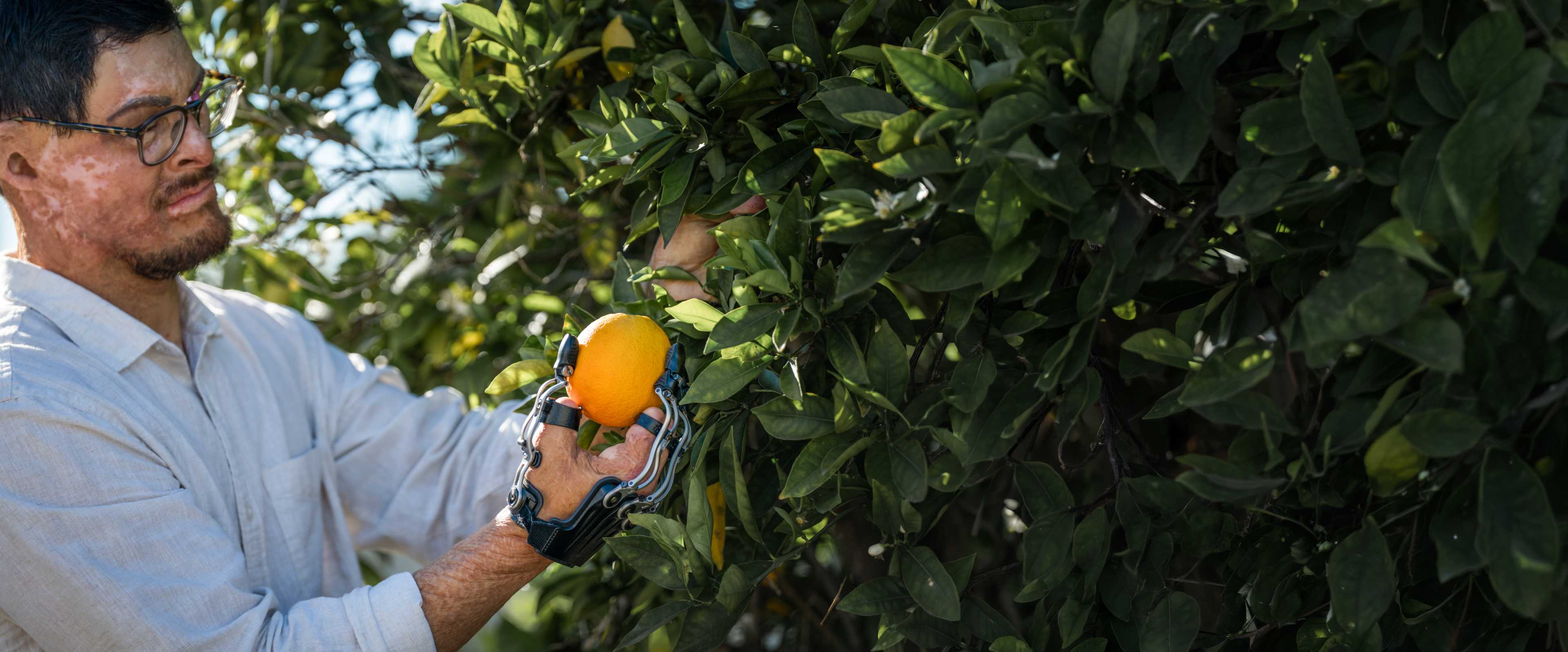
Thomas Craig VIII
"If you can focus on what you can still do and what you still have access to, that mindset can drive you to so many amazing places."
Thomas Craig VIII
Reclaiming Life with Prosthetic Fingers
A life built for the skies
Thomas Craig VIII grew up in Mililani, a tight-knit community on the island of O'ahu, where life revolved around sports, school, and family. After earning his degree from the University of Hawai'i, Thomas built a successful career in sales and marketing in Southern California, eventually landing a role at a global sports brand.
In 2017, he made a decision that surprised everyone, including himself. "I decided that I was going to completely change this really stable career and go for my dream of being a commercial airline pilot," he says. He threw himself into the training, earned his certifications, and finally landed a job as a flight instructor. He was exactly where he wanted to be.
Then, about three months in, everything changed.
When the sky fell
In 2019, Thomas was involved in a catastrophic plane crash. He survived—but the injuries were severe. The crash left him with burns covering nearly 70% of his body, nine finger amputations, and multiple fractures. The physical toll was immense, but Thomas is candid about his struggles: "One of the hardest things was the mental challenge."
The recovery that followed was long and grueling. Through it all, one constant kept him grounded: his then-girlfriend, Kristina, who showed up at the hospital every single day. "I didn't know, was my girlfriend going to be there? Was she going to show up at the hospital every day?" Thomas recalls. "And every day, Kristina would show up at the hospital. It would just light me up. I was like, wow—no matter what I look like, no matter how I feel, no matter the position she sees me in, she's still by me in this circumstance."
Kristina reflects on that time with the same quiet certainty: "I felt like there was nowhere else I wanted to be, even if this was an awful circumstance. I just wanted to be with him every day, to be on this journey with him. And yeah, I think we've grown so much since then—our journey has just unfolded beautifully."
A new chapter: life today
Thomas and Kristina now live in San Diego with their newborn son, and fatherhood has brought Thomas a sense of healing he didn't fully anticipate. "I was really worried: can I still do the things with him that I always thought I'd be able to do?" he says. "Can I throw the ball with him? Can I go ride the bike? Can we go surfing?"
Those fears are real—but so is his answer to them. "It's not weaker or sadder or anything like that. It's still awesome because I care about him. We're going to care about each other, and we're going to go off and do the fun things that I've always liked to do, that I want to pass on to him. And we're going to be able to do it together."
The lessons Thomas learned through recovery have shaped the kind of father he wants to be. "Through the healing process, I learned about mindset, about being positive, about understanding and empathy. I look at him and all the possibilities and all the struggles he might have and all the wins he might have—and I just try to hopefully translate to him: it doesn't matter how tough something is, it's about how you show up every single day and try to be a little bit better."
One of Thomas's weekly rituals keeps him grounded through it all. "One of my biggest sources of joy every week is taking the bike, riding around Miramar, putting on a podcast, and just zoning in and taking laps," he says. "It's totally a week resetter for me. It's a grounding moment—something I look forward to and appreciate so much."
“"Gaining this prosthetic, it's allowed me to be like—no, you're not any less than. There are not things you can't do because of your amputation. Granted, you do it in a different way, but it's not less than."”
Embracing prosthetics
When Thomas first began exploring prosthetic technology, he approached it the way he approaches most challenges: with curiosity and determination. "I found this device online that was perfect," he recalls. "I just wanted to immediately get used to how it was going to feel. I knew there was going to be an adjustment process—but on the side, I was just dreaming about all the things I could do with it. I want to go ride a bike. I want to take it snowboarding. I just want to be useful around the house."
What followed the adjustment period was transformative. "I realized that it is how I look at myself and how I feel about myself that allows me to go out in the world. And this product was a massive part of me finding that confidence."
Kristina saw the change firsthand. "He could do so much more all of a sudden," she says. "He is a different person with it." She also credits the team behind the product: "The company has been so amazing at adjusting it, trying other things—they're really open to listening to him. When you're injured, that's the most important thing: someone is listening to what it is that you actually need."
My prosthetics — owning the journey
Today, Thomas uses the MCPDriver® and ThumbDriver® upper limb prosthetic devices. "Gaining this prosthesis, it's allowed me to be like—no, you're not any less than. There are not things you can't do because of your amputation. Granted, you do it in a different way, but it's not less than."
That philosophy now reaches far beyond his own experience. At the five-year anniversary of his crash, Thomas created a video sharing what he had learned—and the response floored him. "I had so many people reaching out saying how it helped them, how inspired they felt, how comforted they felt." That moment sparked the Sick Burn Podcast, where Thomas hosts conversations with survivors and people who have overcome adversity. What started as a goal of five episodes has grown into something much larger. "I would have never done that had I not pushed through my insecurities about what I was missing and just realized—yeah, but the opportunity you gained here is insane. Just go do it."
For Thomas, his prosthetic device isn’t separate from that story—it’s woven into it. His prosthetic fingers gave him back the physical capability to live the life he's building, and in doing so, gave him the confidence to share it. "That growth has led to extraordinary moments in my life," he says. "I don't take for granted those little gains anymore."
From Mililani to Los Angeles to the skies—and through a crash that would have grounded most people permanently—Thomas Craig VIII has built something unexpected from the wreckage: a life defined not by what was lost, but by what was found.
What Thomas uses
Thomas wears the MCPDriver®, a body-driven prosthesis designed for finger and partial-hand difference, and the ThumbDriver®, designed to restore thumb function and grip. Together, they support Thomas in cycling, daily tasks, and life with his growing family.
Product Links: MCPDriver, ThumbDriver
FAQs
What are prosthetic fingers and how do they work?
Prosthetic fingers are replacement fingers fitted to someone who has either had an amputation of their own fingers or was born without fully formed fingers.
Thomas uses a MCPDriver and a ThumbDriver, these are both body-driven devices. The other body driven device in the family is the PIPDriver. They are all designed for partial finger or thumb absence, where a part of the digit is remaining.
The part of the finger or thumb remaining is what makes the prosthetic move. As the remaining part moves the prosthetic also moves allowing the bending and straightening of the finger / thumb to be restored.
What types of prosthetic fingers are available?
The PIPDriver is designed for absence through the middle bone of the finger.
The MCPDriver is designed for absence of the finger closer to the hand.
The ThumbDriver is designed for absence of part of the thumb.
These are all body-driven – meaning they move with the movement of the remaining part of the finger.
What if the complete finger is absent?
For full finger absence, where there is no portion of the finger remaining, a GripLock Finger is available. This is a mechanical ratcheting prosthetic finger which is positioned using the other hand, or by pushing the prosthetic finger against an object.
Once the GripLock finger is positioned it can support in holding objects, with the active grip provided by the user’s thumb. It is only for full finger absence, not for thumb absence.
How long does it take to get a prosthetic finger fitted?
Each prosthetic finger is made specifically for the individual. Therefore, this can take time to get the optimum fitting and function. It may need to be adjusted after the first fitting.
Once fitted with a prosthetic there may also be a bit of a learning curve to adjust to how to best complete daily activities or hobbies using the prosthetic.
Time and patience are both important to adjust to a new way of doing things – and as Thomas described it may be in a different way than before.
Can prosthetic fingers restore full function?
Prosthetic fingers won’t restore all the complex functions of the fingers. But they are designed to provide grip stability when completing tasks and encourage both hands to work together in daily activities. The body driven devices should also protect the remaining finger from impact and abrasion and be comfortable to wear.
What are the best prosthetic fingers for an active lifestyle?
The types of activities you want to do is one of the key factors when determining the right prosthetic for you. Mechanical prostheses are designed for heavy duty tasks and can be exposed to wet and dirty environments; but can equally be useful in lighter activities such as food preparation. Bionic prostheses have active powered digits but are for low to medium duty tasks and should not be exposed to water. Cosmetic prostheses have no active grip, but can provide support in tasks by pushing, pulling and stabilizing.
Can you get a prosthetic for just a thumb?
The thumb is very important to the overall function of the hand, so loss of the thumb is very impactful. A prosthetic thumb is available. It can be fitted for thumb only absence, or also in conjunction with prosthetic fingers if the fingers are also affected.