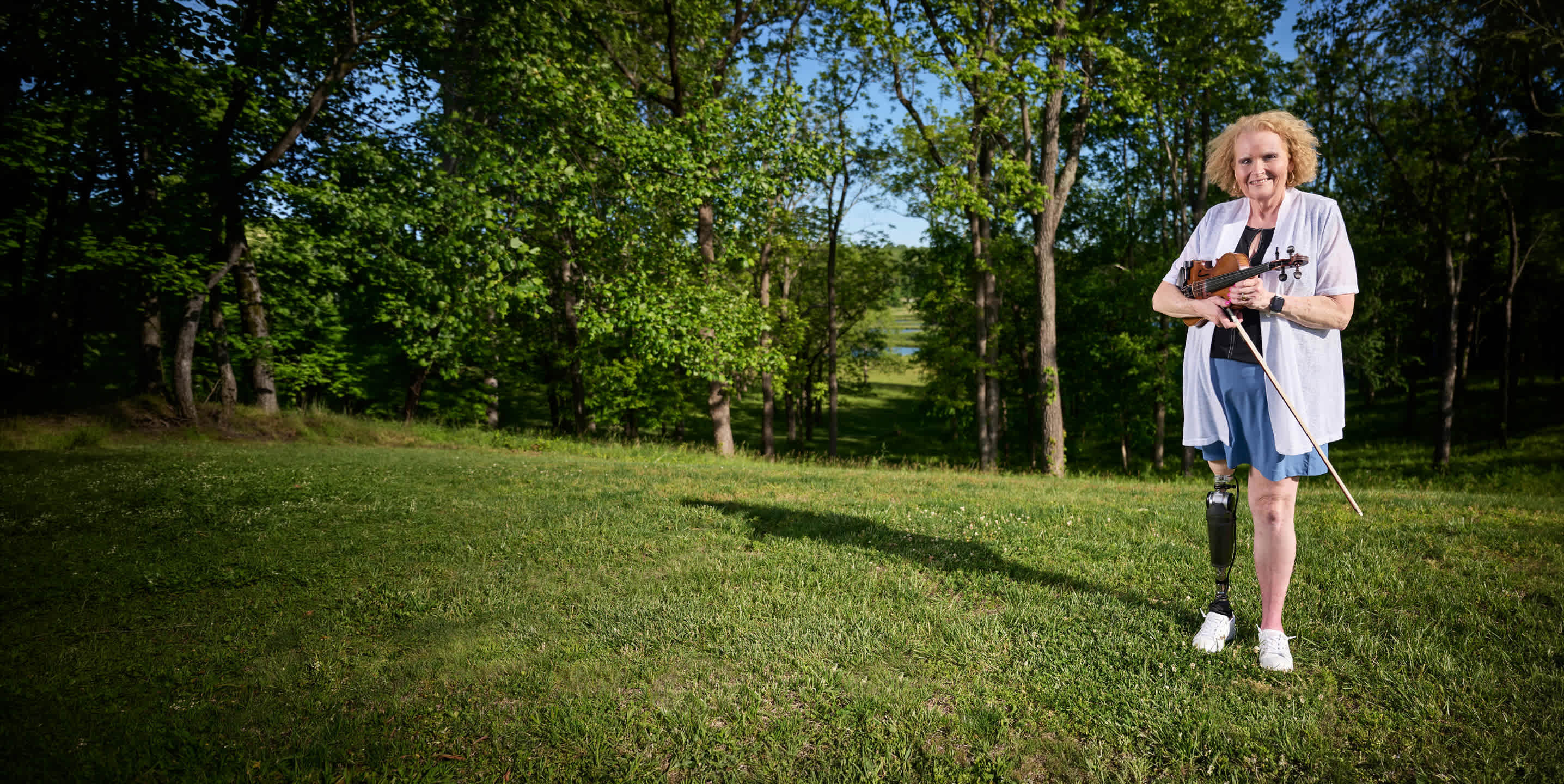
Lynne Cox
"Every day is a challenge. And I meet that head on."
Lynne Cox
A Life in Full: Teaching, Music, and Moving Forward After Amputation
A life built on melody
Lynne Cox has always moved to music. Growing up, her mother—a music major—filled the family home in Indiana with melody, and all the children played instruments. "We'd play as a family at nighttime," Lynne recalls, smiling. Her father would joke that he was going to hold the can for donations. It was that kind of house: warm, full, always humming.
That early love never left her. Today, Lynne plays the violin in her community band in Martinsville, Indiana, and also sings in her church choir and plays in the bell choir. "I've been playing bells since I was sixteen years old," she says. "It has been a wonderful, fun experience–very much a journey–and still is." The band has become something larger than music for Lynne: a community and a confidence-builder.
Alongside her music, Lynne spent decades as a teacher—a career she describes as one of the most fulfilling chapters of her life. "Teaching school meant that I had to be up on my feet. I had to be walking around the classroom, on the floor with the kids, right there with them." For Lynne, teaching wasn't just a job. It was a vocation—and it demanded everything she had to give.
When everything changed
In 2018, Lynne made one of the hardest decisions of her life. Complications from a knee replacement surgery led to pain and reduced mobility. "I could see that I wasn't going to be able to do my job," she says. "So I chose to retire earlier than I wanted to. I didn't want the kids to not get what they needed because I wasn't able to do what I needed to do." She pauses. "But it broke my heart for a while there. It devastated me. Still does, to a certain point."
Lynne underwent a below-the-knee amputation—and later, a second surgery that took more of her leg. It was a lot to absorb. But even then, her focus was on what came next. "Nobody wants to have more leg taken off," she says. "But being able to get up on it and walk and do things—that was wonderful."
Her husband John watched it all unfold with equal parts awe and love. "Her resilience and how fast she bounced back—to me that would have been devastating," he says. "But she just had that mental attitude right from the start: we're going to get through this, we're going to conquer this. I'm not going to spend my life in a wheelchair."
A new chapter: life today
Life in Martinsville now is full—exactly the way Lynne wants it. Her weeks are shaped by the things and people she loves most: her grandchildren, her husband, her sister, her church, and, of course, her music. "Kind of a boring life to some, I suppose," she says—though everything about how she says it suggests she disagrees.
At the heart of that life are her grandchildren. Lynne and John are deeply involved grandparents, and several days a week Lynne looks after Lorelai, her five-year-old granddaughter. Their days together have a gentle, unhurried rhythm—mornings in the garden pulling weeds and planting, afternoons in the kitchen measuring flour and decorating cookies. "Her play is her learning," Lynne says. "I let her measure when we make the cakes or the cookies. That type of thing." The teacher in Lynne has never really clocked out.
The garden has become a special place for the two of them—somewhere Lorelai can dig in the dirt and watch things grow, and somewhere Lynne can move at her own pace, on her own terms. It is exactly the kind of activity she once feared amputation might take from her. Instead, it has become one of the things she treasures most.
The other grandchildren each have their own corner of Grandma's world too. Hunter loves Play-Doh. Brooke is still discovering what she's drawn to, and Lynne is in no rush. "My teaching has helped me see things I can pull out—crafts we can do together." John sees it clearly: being able to be present and active with the grandchildren has been one of the most meaningful gifts Lynne's mobility has given them both. "It's good to see her become more independent and be able to do more things," he says. "It helped her mental health—and not having to rely on me to have to do this or that."
At church, Lynne has taken on an ambitious new role: organizing the Wednesday night community dinners. "It's a pretty big time commitment," notes a fellow church member. "Takes a lot of energy and work." That she does it with a prosthetic leg is, to those who know her, simply part of who she is. "She's more active than most people I know," says another. "Her prosthetic leg does not stop her from doing anything."
“"All of a sudden I could just walk and I thought—I don't need this cane. Let's just get rid of it. And I did. I just pushed it off to the side and started walking. And it just was so wonderful."”
Embracing the Power Knee
Because of her level of activity, Lynne's care team moved her to the Power Knee relatively early in her journey. "You have to demonstrate the things you're going to do and that you are active, you're going to stay active, to get that Power Knee," John explains. "And that's really propelled our life a lot."
For Lynne, the shift to the Power Knee marked a turning point in her independence—something she had fought hard to reclaim. In the early days of recovery, the people who loved her most were also her biggest obstacle. "Nobody wanted me to do anything. They were so afraid to let me do anything," she says with a laugh. "And I said, well, nobody wants to fall. But that's what's going to have to happen until I get to the point that I can do what I need to do."
Then came the moment she'd been working toward. "All of a sudden I could just walk, and I thought—I don't need this cane. Let's just get rid of it. And I did. I just pushed it off to the side and started walking. And it just was so wonderful to not have to have something in my hand or something helping me."
"Going to church. Going to concerts. Going up into an auditorium. Those ramps are horrible sometimes. But I said, these are things I need to do. The independence was a struggle—but I finally got people to realize that I can do it." Because of her level of activity, Lynne's care team moved her to the Power Knee relatively early in her journey. "You have to demonstrate the things you're going to do and that you are active, you're going to stay active, to get that Power Knee," John explains. "And that's really propelled our life a lot."
For Lynne, the shift to the Power Knee marked a turning point in her independence—something she had fought hard to reclaim. In the early days of recovery, the people who loved her most were also her biggest obstacle. "Nobody wanted me to do anything. They were so afraid to let me do anything," she says with a laugh. "And I said, well, nobody wants to fall. But that's what's going to have to happen until I get to the point that I can do what I need to do."
Then came the moment she'd been working toward. "All of a sudden I could just walk, and I thought—I don't need this cane. Let's just get rid of it. And I did. I just pushed it off to the side and started walking. And it just was so wonderful to not have to have something in my hand or something helping me."
"Going to church. Going to concerts. Going up into an auditorium. Those ramps are horrible sometimes. But I said, these are things I need to do. The independence was a struggle—but I finally got people to realize that I can do it."
My prosthetic — a perfect part of me
Of all the milestones Lynne has reached since her amputation, one stands above the rest. It had been at the top of her bucket list from the very beginning: to dance with her son at his wedding.
"There wasn't a dry eye that night when she took the dance floor," John says.
Lynne smiles at the memory. "That was very emotional. That was one of the biggest things on my list. Being able to dance with my son at his wedding, to enjoy that time with him, to enjoy his day. So yeah. That was very important."
John credits the Power Knee with making moments like that possible. "It's been a marvel to us—to be able to get her increased mobility and back to semi-normal. As normal as we're ever going to get." He adds: "It might take you a little longer to get dressed in the morning or get ready for bed. But you can still live your life."
Lynne's advice to others navigating a similar path is simple and hard-won: "Be positive. Always have some people in your corner that you know are going to support you."
From a childhood filled with music to a classroom full of kids, from a surgery that changed everything to a dance floor at her son's wedding—Lynne Cox has met every challenge head on. Her Power Knee hasn't just restored her mobility. It's helped her keep moving toward everything that matters most.
What Lynne uses
Lynne wears the Power Knee®, Össur's industry-leading powered prosthetic knee that provides active assistance for above-knee amputees, enabling a more natural, confident gait and greater independence across everyday activities.
Product Links: Power Knee
FAQs
What is Power Knee?
Power Knee is an actively powered microprocessor knee (MPK). Traditional passive MPKs use resistance to control motion. Power Knee is different in that it creates motion through motor-generated power.
What benefits can Power Knee provide to amputees?
Long-term prosthetic use can be associated with a range of secondary health consequences, like osteoarthritis and gait compensations that lead to overuse injuries. By actively assisting knee movement, Power Knee helps reduce the energy required for walking and promotes greater symmetry in sit-to-stand activities.
Who is a suitable candidate for a Power Knee?
Adding power to a prosthesis can provide benefits to a wide range of users. Power Knee's versatility and adaptability make it suitable for all types of people with above knee amputations, including those with unique needs, supporting mobility and independence in everyday life.
How does Power Knee improve mobility on inclines and stairs?
Navigating up stairs and inclines requires a lot of effort, both physically and mentally. Power Knee provides powered knee extension, creating motion that would otherwise need to be completely generated by the user.